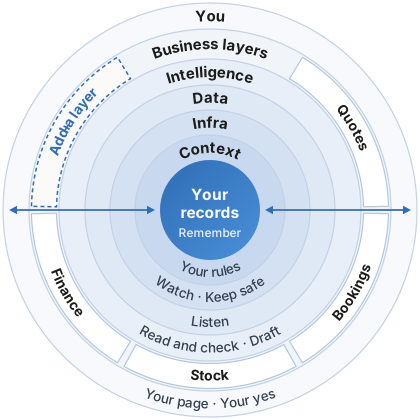
It isn't a chatbot, a bundle of automations, or a subscription to someone else's product. It's the system I run my own companies on, and every business gets its own copy.
The nine layers
Your records sit at the centre. Every layer works from them, and talks to the others through them.
Live means running today. Our kit means proven on our own kit, with nothing of the customer's touched. Built, switched off means ready and waiting to be proven. Planned means designed, not built yet.
At the centre, your records.
Everything the business knows, filed in its own database, and nothing overwritten.
RememberFiles everything in the business's own records, and never overwrites
My own businesses
One database, with stock kept as one line per movement. Live
A building supplies merchant
Separate records for messages, prices and documents, with every price list kept as a dated version you can roll back. Live
A plumbing firm, on our own kit
One record per enquiry, with every photo and video kept whole. Our kit
Context.
Your rules, your way of working and what it has learned, written down, so everything works the way your business does.
Your rulesYour way of working, written down
My own businesses
Rules for paying by the unit. Live
A building supplies merchant
Price from his own sell price, or what he paid plus his margin. Thin or below cost lines are flagged, never blocked. Live
A plumbing firm, on our own kit
The firm's own urgency levels and job types, and its rule never to promise a diagnosis, a time or a price. Built, switched off
The parts a business dials in, drawn as slices of one ring.
Quotes, for a building supplies merchant, Live.
Bookings, for a plumbing firm, Our kit.
Stock, in my own businesses, Live.
Finance, payments matched from the bank in my own businesses, Live.
Add a layer.
When a business needs something that isn't there, it's built as a new layer, it plugs into the rings, and the next business can use it too. Your records and your rules stay yours.
You.
The outside ring. Your own page, and your yes. Nothing reaches a customer without it, or a kind of message you've approved to go on its own.
Your pageA web page behind your own login, on your own web address
My own businesses
A stock page my customer logs into. Live
A building supplies merchant
His price page, on phone, tablet or laptop. Live
A plumbing firm, on our own kit
Planned
Your yesNothing reaches a customer without your yes, or a kind of message you've approved to go on its own
My own businesses
I approve and send every buyer reply. Live
A building supplies merchant
He sends every quote himself, and the link has no way to send. Live
A plumbing firm, on our own kit
Every customer message held for a person's yes. Built, switched off. The approval screen is planned
Every business gets its own copy, built from parts already proven in another business. When a part doesn't exist yet, we build it, and it becomes one more part.
Dialled in, the web page. I built it in July so a customer of my own could log in and see live stock. In August its login and publishing became a merchant's price page on his own web address, and neither was built twice. It's planned as the plumbing firm's screen next.
Added, the results check. In August a customer's price request never reached the merchant's board, while the nightly check said everything was healthy. It checked the parts, not the results. So we added checks on the results. The plumbing build started with them.
Added, the two way connection. The merchant's link reads and never sends. The plumbing firm wanted each enquiry asked the right questions, so we added Meta's official two way connection. Proven on our own kit.
How it learns
It learns the plain way, by writing down what you teach it. For the merchant, it works like this today.
Every tap that links a line to a product is kept, so the same wording prices itself next time.
Every supplier invoice he gets is read, so the next quote knows more.
Every customer he types on a quote is remembered and offered back.
Because the learning is written down, a wrong lesson can be found and taken back out.
Why single bots don't scale
Most businesses that try AI end up with islands. There's one tool for messages, another for quotes and another for invoices, each with its own login and its own copy of the facts.
Nothing is shared. One tool never knows what another learned.
The glue grows. Every new tool needs joining to every other one.
They break quietly. Nobody notices until a customer does.
Nothing compounds. Tool number ten is no smarter than tool number one.
Starky OS keeps one set of records per business, and every layer works from it. Single automations speed up tasks. An operating system compounds a business.
You own it.
Your records. You get them in plain files, on a machine you own or a server in your name. If your build starts on my kit, the move to yours is part of the job.
Open standard tools. It's built on tools anyone can run. SQLite holds each database in a single file, and its makers intend to support it through 2050. The US Library of Congress lists it as a recommended format for keeping digital content. Around it sit Python, plain files, a full history of every change, and the scheduler already built into your computer or server.
What leaves the machine, honestly.
The AI reads the words it's working on, through Claude, an AI made by Anthropic.
WhatsApp messages travel through Meta, as they always do.
A web page's data sits with the company that hosts the page.
How it's guarded
Nothing reaches a customer without your yes, or a kind of message you've approved to go on its own.
The read only WhatsApp link has no way to send at all.
Every change is checked by a second reviewer before it goes live.
Every build checks itself every day, the parts and the results.
A checked copy is kept every day.
The worst case, said out loud. If it stops, your WhatsApp and your phones carry on exactly as before, and you're back to doing it by hand until it's fixed. You don't lose your messages.